Publication Link
Why Look at “Diagnostic Reversion”?
Link to heading
Mild cognitive impairment (MCI) is usually framed as a precursor to dementia. So when an electronic health record (EHR) shows a patient labeled with dementia first and an MCI code later, something is off. Either the original dementia diagnosis was premature, or the MCI label is wrong. Understanding how often this happens, and which patients it happens to, can expose gaps in clinical decision-making, highlight health-equity issues, and show where diagnostic pathways need tightening.
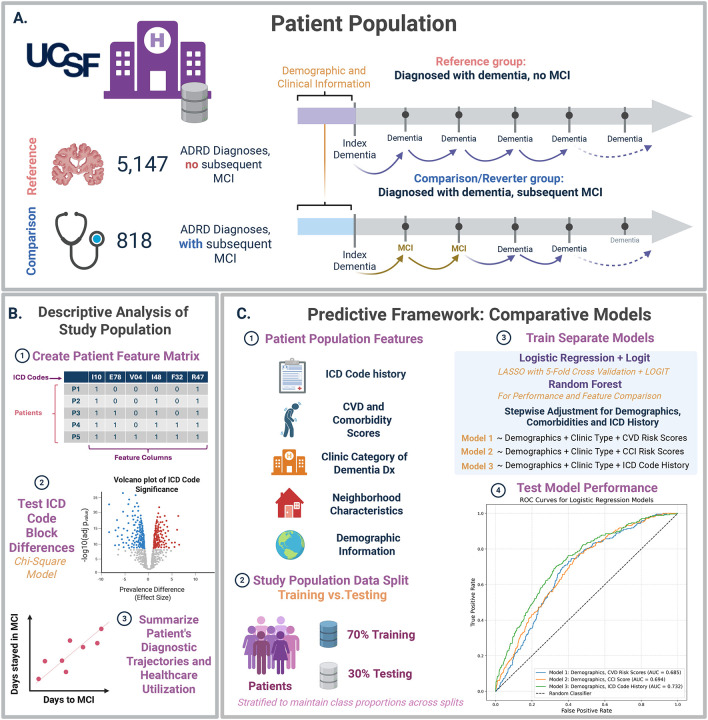
- Cohort: 5,965 UCSF Health patients, age ≥ 50, with an incident dementia diagnosis between 1988–2024.
- Groups:
- Reference (86.3%, N=5,147): Dementia diagnosis without any later MCI code.
- Reverters (13.7%, N=818): Received an MCI diagnosis after the initial dementia code.
- Data source: Structured ICD-9/ICD-10 codes extracted from the UCSF EHR.
- Predictors: Demographics, preferred language, clinic type, cardiovascular-risk scores, Charlson Comorbidity Index (CCI), and a binary matrix of 101 aggregated ICD-block codes (derived from >1,900 raw codes).
- Feature construction: built a patient-level matrix of binary ICD-block presence, plus continuous/compositional covariates.
- Descriptive statistics: chi-square tests (Benjamini-Hochberg corrected, p < 0.01) identified 39 ICD blocks differing between groups.
- Predictive modeling:
- Group LASSO-regularized logistic regression (5-fold CV) for feature selection.
- Standard logistic regression (LOGIT) on the selected features for coefficient estimation.
- Parallel random-forest models for non-linear comparison.
- Evaluation: stratified 70/30 train-test split; performance measured with AUROC, AUPRC, and threshold-optimized F1 scores.
| Overview |
|---|
 |
| Variable | Direction of Association (Test Set) |
|---|
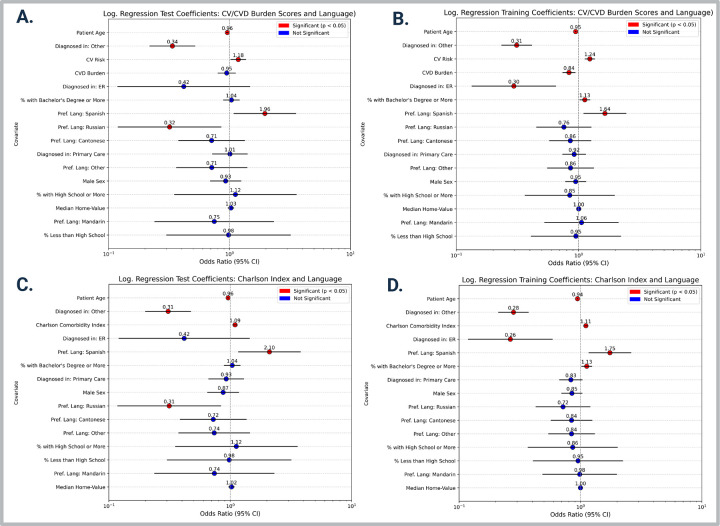
| Younger age | Higher odds of reversion |
| Spanish-language preference | Higher odds of reversion |
| Higher cardiovascular-risk score | Higher odds of reversion |
| Higher Charlson Comorbidity Index | Higher odds of reversion |
| Diagnosis in “other specialty” clinics | Lower odds of reversion |
| Russian-language preference | Lower odds of reversion |
| Results |
|---|
 |
- More common in reverters: dizziness/giddiness (R42), depressive episodes (F32), osteoarthritis (M19), cataracts (H25/H26), dorsalgia (M54), unspecified injuries (T14), atherosclerosis (I67), immunization encounters, diverticular disease, and various spondylopathies.
- More common in stable dementia: chronic kidney disease (N18), atrial fibrillation (I48), fluid/electrolyte disorders (E87), abnormal lung imaging (R91), long-term drug therapy (Z79), brain disorders (G93), respiratory disorders (J98).
- Logistic regression (best specification): AUROC ≈ 0.74, AUPRC ≈ 0.32. Threshold tuning (maximizing F1) lifted sensitivity to ≈ 0.75 and F1 to ≈ 0.35.
- Random forest: AUROC ≈ 0.73, AUPRC ≈ 0.31; F1 after tuning ≈ 0.38.
- Interpretability: The logistic models give calibrated odds ratios, which makes clinical translation straightforward. The random forests discriminated about as well but with less transparent effect sizes.
What Does This Mean for Practice?
Link to heading
- Diagnostic Uncertainty Is Real and Structured: Roughly one in seven dementia patients later receive an MCI label, which points to systematic over-diagnosis or inconsistent coding.
- Language Barriers Matter: Spanish-speaking patients had about twice the odds of reversion, hinting at communication gaps, insufficient interpreter use, or differences in how symptoms present across cultures.
- Younger Patients Are Vulnerable: Younger age correlates with higher reversion, possibly because early-onset dementia is rarer and clinicians may walk a premature dementia label back.
- Comorbidity Load Influences Coding: Higher CCI scores raise reversion odds, perhaps because complex medical histories blur cognitive assessments.
- Clinic Setting Shapes Certainty: Diagnoses made in dedicated dementia clinics or primary-care settings reverted more often than those made in the ER or “other specialty” clinics, which argues for specialist input and longitudinal follow-up.
Practical Takeaways for Clinicians & Health Systems
Link to heading
- Implement Structured Follow-Up Protocols after a dementia diagnosis, especially for younger and Spanish-speaking patients, to confirm or refine the label.
- Standardize Cognitive Assessment Documentation (e.g., MoCA, MMSE) in the EHR to reduce reliance on billing codes alone.
- Invest in Language-Concordant Care: interpreter services, bilingual clinicians, and culturally adapted screening tools can mitigate misclassification.
- Use Predictive Alerts: a lightweight logistic-regression-based risk score (using age, language, CVD risk, CCI, and a handful of high-impact ICD blocks) could flag patients at elevated reversion risk for multidisciplinary review.
- Audit Coding Practices regularly to ensure that ICD transitions reflect genuine clinical change rather than administrative convenience.
- Billing-Code Reliance: ICD entries may miss nuance, especially for subtle cognitive changes.
- Single-Site Cohort: UCSF’s academic environment limits generalizability to community hospitals or rural systems.
- Unstructured Data Excluded: Narrative notes, neuropsychological test scores, and medication records could refine the phenotype but were not incorporated.
- Class Imbalance: The 13.7% reversion rate constrained model precision; future work should explore oversampling or synthetic minority techniques.
- Multi-Center Validation: Apply the same pipeline to other health systems (e.g., Kaiser, VA) to test external robustness.
- Natural-Language Processing: Extract cognitive assessment scores and clinician impressions from progress notes to complement structured codes.
- Intervention Trials: Randomize flagged high-risk patients to intensified diagnostic review versus usual care to measure impact on diagnostic stability and downstream outcomes (e.g., medication appropriateness, care planning).