Why Look at Words, Not Just Numbers? Link to heading
When you sift through millions of electronic health-record notes, the obvious data points (diagnosis codes, lab values, medication lists) are easy to count. What’s harder to capture is how clinicians talk about a patient’s condition. That language reflects shifting attitudes, workflow pressures, and changing standards of care. In a new Scientific Reports article, we show that even a simple word-embedding model can pick up those trends.
The Core Idea: Word2Vec Meets the Ward Link to heading
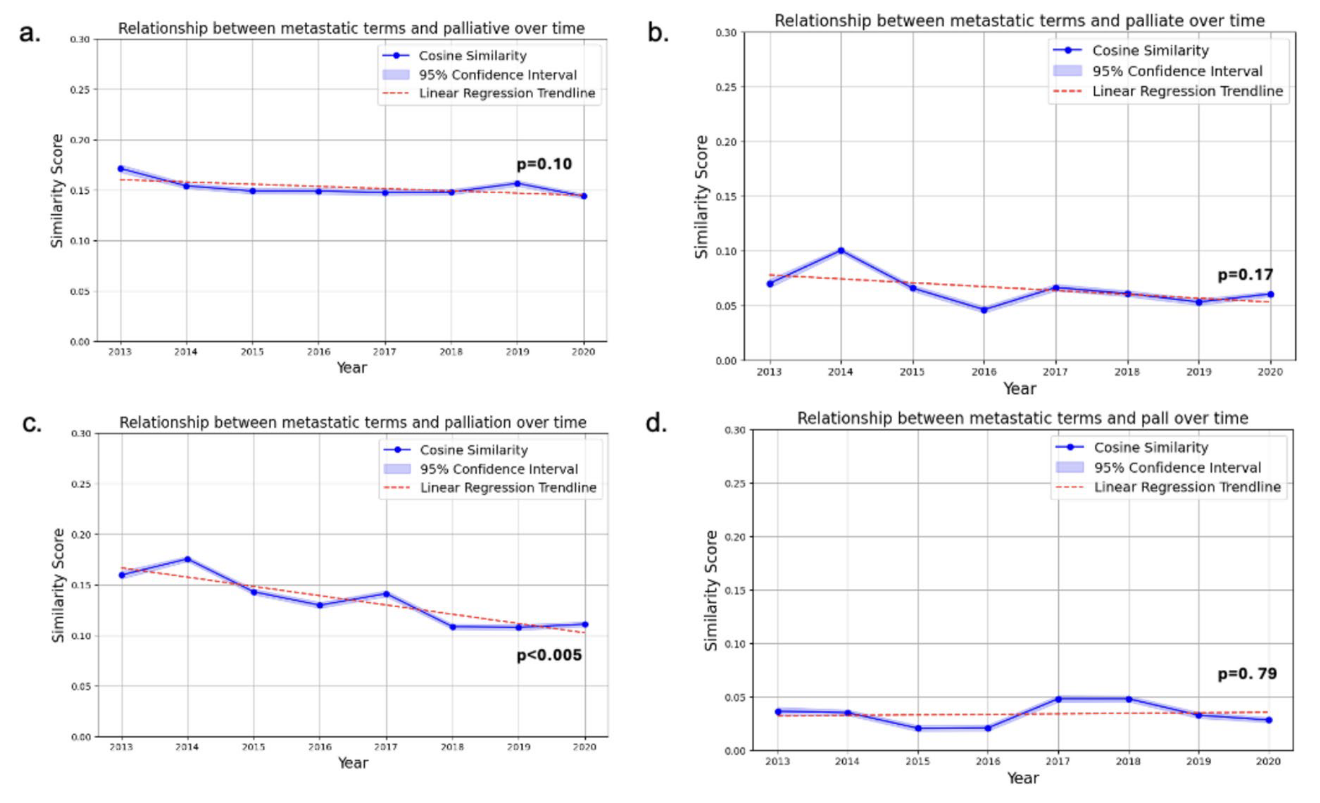
We fed every inpatient note from 2013-2020, over 28 million notes, into a series of Word2Vec models, one per year. Word2Vec turns each token into a high-dimensional vector that encodes its context. Computing the cosine similarity between vectors for “metastatic” terms and “palliative-care” terms then quantifies how tightly the two vocabularies were linked in everyday documentation.
What Did We Find? Link to heading
- Positive baseline similarity: Across all years, metastatic and palliative terms co-occurred more often than random chance, confirming that clinicians routinely discuss both in the same chart.
- A slow drift apart: Linear regression revealed a modest decline in similarity, most pronounced for the noun “palliation.” The drop was statistically significant, suggesting a real change in phrasing rather than noise.
- Robustness checks: When the analysis was limited to patients with a confirmed metastatic-cancer ICD code, the same downward trend persisted, albeit with larger confidence intervals (fewer notes, more variability).
| Terms over Time |
|---|
 |
Interpreting the Drift Link to heading
We need to be careful not to equate lexical change with clinical practice change. A weaker lexical bond could mean:
- Documentation fatigue: Clinicians may be using shorthand or omitting palliative-care language as they become accustomed to standard pathways.
- Shift to “primary” palliative care: More of the palliative work may be happening within primary services, where the term “palliative” is used less explicitly.
- Evolving terminology: New therapies and care models (e.g., immunotherapy) might push the conversation toward disease-specific language rather than generic “palliative” descriptors.
Why This Matters for ML Engineers Link to heading
- Proof of concept for unsupervised NLP: Even a classic static embedding model can detect temporal semantic drift without any labeled data.
- Feature engineering insight: When building predictive models from clinical text, relying solely on keyword presence may miss nuanced shifts; embedding-based similarity can be a richer feature.
- Future directions: Transformer-based models (e.g., BERT) could capture context-dependent meanings and perhaps detect more subtle drifts, especially in the era of “semantic shift” research.
Takeaways for the Healthcare Community Link to heading
- Audit your documentation: Regular NLP audits can flag unintended changes in language that might affect downstream analytics or quality metrics.
- Combine quantitative and qualitative: Pairing embedding trends with clinician interviews would validate whether the observed lexical drift reflects genuine practice evolution.
- Expand beyond the inpatient setting: Outpatient and telehealth notes could reveal whether the trend is universal or confined to acute care environments.
Bottom Line Link to heading
The main takeaway is that how notes are written carries as much information as what they contain. Tracking term similarity over time gives us a cheap, label-free way to watch palliative-care documentation for metastatic cancer patients change, no extra data fields required. If you build ML pipelines on EHR text, that drift matters: a model trained on 2013 language is not quite seeing the 2020 version of the same chart.