Introduction Link to heading
Fairness assessments for medical AI, especially devices like pulse oximeters and dermatology classifiers, often rely on subjective skin-tone scales such as Fitzpatrick and Monk. Our recent prospective study, published in npj Digital Medicine (2025), shows these scales are far from reliable. Below I walk through the study and what it means for anyone building or auditing healthcare AI systems.
Why the Question Matters Link to heading
- Clinical stakes: Pulse-oximeter readings that over-estimate oxygen saturation in darker-skinned patients have already been linked to delayed treatment and higher mortality.
- Algorithmic bias: Computer-vision models trained on under-represented skin tones misclassify lesions, widening diagnostic gaps.
- Regulatory pressure: The FDA now urges developers to evaluate devices across diverse pigmentations, often using the Fitzpatrick scale as a proxy.
But are these scales truly measuring what we think they are?
Study Design at a Glance Link to heading
| Aspect | Details |
|---|---|
| Population | 90 hospitalized adults (median age 72 years, 77% male) from the San Francisco VA Medical Center. |
| Images | 810 facial photographs (3 facial regions × 3 repeats per patient). |
| Scales Tested | Fitzpatrick (I–VI) and Monk (1–10). |
| Annotators | Three independent raters of diverse ethnic backgrounds; each rated every image in triplicate. |
| Patient Input | Self-reported skin tone on both scales. |
| Metrics | Cronbach’s α (internal reliability), ICC(2,k), weighted Cohen’s κ, Kendall’s W, Krippendorff’s α, paired t-tests, Spearman ρ, mixed-effects regression, Bland-Altman plots. |
All statistical work was done in Python (v3.12) on a consolidated Pandas dataframe.
| Study Design |
|---|
 |
Key Results Link to heading
- Internal Consistency is High: Cronbach’s α ranged from 0.88–0.93 for both scales, indicating each annotator was internally reliable.
- Inter-Annotator Agreement is Moderate-to-Low
- ICC(2,k): 0.66 (Fitzpatrick) and 0.64 (Monk).
- Weighted Cohen’s κ (pairwise): 0.63/0.64 (Annotator 1 vs 2) but dropped to 0.29–0.39 for other pairs.
- Kendall’s W (overall ranking): 0.90 (Fitzpatrick) vs 0.85 (Monk).
- Krippendorff’s α: 0.41 for both scales.
- Systematic Bias Between Patients and Annotators
- Paired t-tests showed significant differences (p < 0.001): annotators tended to assign lighter scores than patients reported.
- Spearman correlations between the difference (annotator – patient) and the patient’s self-score were strongly negative (−0.82 for Fitzpatrick, −0.84 for Monk).
- Mixed-Effects Model Highlights Predictors
| Variable | Fitzpatrick β (p) | Monk β (p) |
|---|---|---|
| Self-reported score | −0.727 (p<0.001) | −0.823 (p<0.001) |
| Annotator confidence = 4 | 0.157 (p=0.043) | 1.293 (p<0.001) |
| Annotator confidence = 5 | 0.581 (p<0.001) | 1.726 (p<0.001) |
| Right cheek (vs. forehead) | 0.385 (p<0.001) | 0.299 (p<0.001) |
| Left cheek (vs. forehead) | 0.057 (not significant) | 0.028 (not significant) |
Higher self-reported skin tones predict lower annotator scores, even after accounting for facial region and confidence.
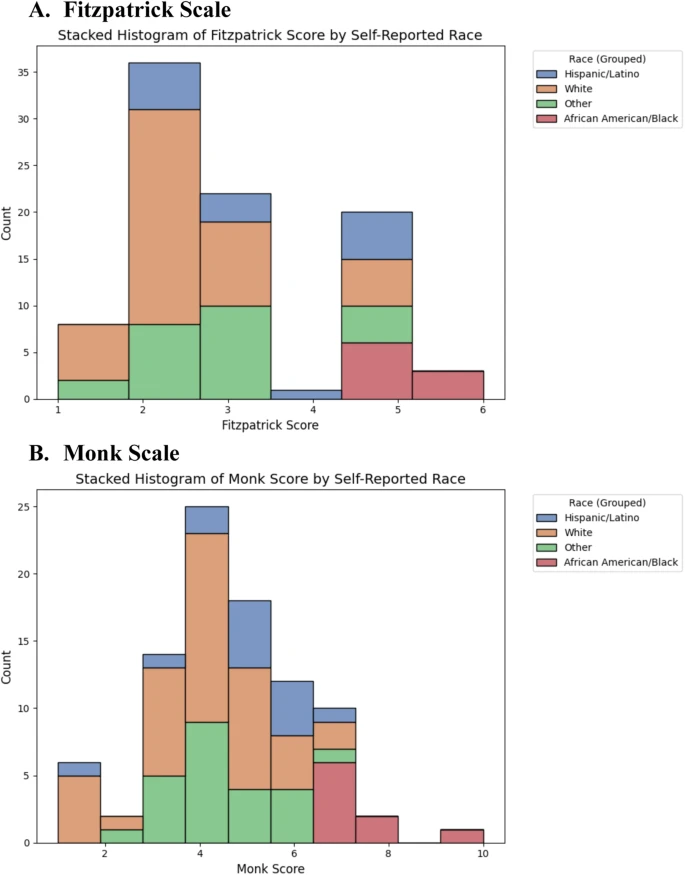
- Visualization: Violin plots and Bland-Altman charts illustrate that annotators cluster around the mid-range, whereas patients gravitate toward the extremes of each scale.
| Patient Self Identified Skin Tone Scores |
|---|
 |
| Comparing Annotator and Patient Scores |
|---|
 |
What This Means for Fairness Audits Link to heading
- Subjective scales are noisy: Even with trained raters, agreement is only moderate. Relying on a single annotator or a small pool can dramatically skew bias estimates.
- Self-report vs. perception gap: Patients systematically rate themselves darker (or lighter) than external observers. Audits that compare algorithm performance against “ground-truth” skin-tone labels may be comparing against a biased reference.
- Facial region matters: Right cheek images yielded higher scores; lighting and pose variations can introduce systematic error.
- Confidence improves consistency: Higher annotator confidence correlates with higher (darker) scores, suggesting that training annotators to recognize uncertainty could reduce bias.
Recommendations for Practitioners Link to heading
- Use Multiple, Diverse Annotators: Aim for ≥ 5 raters with balanced demographic backgrounds; compute consensus scores with robust statistics (e.g., median rather than mean).
- Combine Subjective and Objective Measures: Where feasible, supplement scales with spectrophotometric melanin indices or calibrated imaging devices.
- Standardize Image Capture: Control lighting, camera settings, and facial pose; record metadata to adjust for systematic regional effects.
- Report Uncertainty: Include confidence intervals for inter-rater metrics and disclose the annotator-patient disagreement magnitude.
- Document Annotation Protocols: Publish detailed guidelines (e.g., visual analog references, calibration exercises) so that future studies can replicate or improve upon them.
Limitations of Our Study Link to heading
- Sample size & demographics: Only 90 patients, predominantly White and male; results may not generalize to broader populations.
- No objective melanin reference: We relied solely on subjective scales; future work should incorporate spectrophotometry.
- Single-institution setting: All images came from a VA hospital; lighting and environmental factors may differ elsewhere.
Closing Thoughts Link to heading
Subjective skin-tone scales, despite their ubiquity, should not be the sole fairness metric for medical AI. Their moderate inter-rater reliability and the systematic gap with patient self-reports can mask real disparities or manufacture ones that aren’t there. Multiple diverse annotators, objective pigment measurement, and honest uncertainty reporting would go a long way.