Publication Link
Traumatic brain injury is usually treated as an acute event, but the consequences can stretch far beyond the initial hospitalization. Our recent cohort analysis, published in JAMA Network Open (Dec 2024), adds a large, geographically distinct dataset to the literature. By linking five University of California health-system records (2013-2022) with a previously examined Massachusetts cohort, we get a clearer picture of how a single TBI episode reshapes a patient’s health trajectory for up to a decade.
| Element | Details |
|---|
| Population | 20,400 adults (≥18 years) with a first-recorded TBI (5,100 mild, 5,100 moderate-to-severe) and 10,200 matched controls without TBI. |
| Matching variables | Age, race/ethnicity, sex, UC site, insurance type, Area Deprivation Index (ADI) quintile, and time from index date to last encounter. |
| Follow-up | Median 3.4–3.6 years (range up to 10 years) after the 6-month “wash-out” period. |
| Outcomes | 22 incident comorbidities spanning neurological, psychiatric, cardiovascular, and endocrine domains, identified via ICD-9/10 codes.AnalysisCox proportional-hazard models (adjusted for demographics, ADI, insurance, site). Stratified analyses by age group (young 18-40, middle 41-60, older 61-90) and ADI quintile (low 1-2 vs. high 9-10). |
- Across-the-board risk elevation – Any TBI raised the hazard ratio (HR) for nearly every condition examined.
- Neurological outcomes
- Seizure disorder: HR ≈ 3.3 (both severity levels).
- Dementia: HR ≈ 4.0 (mild) and 3.3 (moderate-severe).
- Psychiatric outcomes
- Depression: HR ≈ 2.6 (mild) and 2.2 (moderate-severe).
- Suicidality (ideation/attempt): HR ≈ 2.5 (mild) and 2.7 (moderate-severe); spikes to HR ≈ 4.8 in middle-aged adults.
- Substance misuse (alcohol, opioids) and anxiety showed ≥ 2-fold increases.
- Cardiovascular outcomes
- Hypertension: HR ≈ 1.4.
- Hyperlipidemia: HR ≈ 1.35.
- Coronary artery disease: HR ≈ 2.2 (moderate-severe).
- Endocrine outcomes
- Hypothyroidism: HR ≈ 1.3–1.35.
- Diabetes: HR ≈ 1.3–1.4.
- Pituitary dysfunction and adrenal insufficiency rose markedly in the moderate-severe group (HR ≈ 1.6–3.1).
- Age-specific patterns
- Middle-aged (41-60 years) patients bore the greatest relative surge in suicidality (≈ 4-fold).
- Younger adults showed heightened seizure and dementia hazards; older adults retained elevated cardiovascular risk.
- Neighborhood disadvantage (ADI)
- Both low and high ADI quintiles exhibited amplified neuropsychiatric risk, but the direction of some comorbidities diverged.
- High ADI amplified bipolar disorder, opioid misuse, and suicidality; low ADI correlated with higher cardiovascular incident rates.
| Hazard Ratios |
|---|
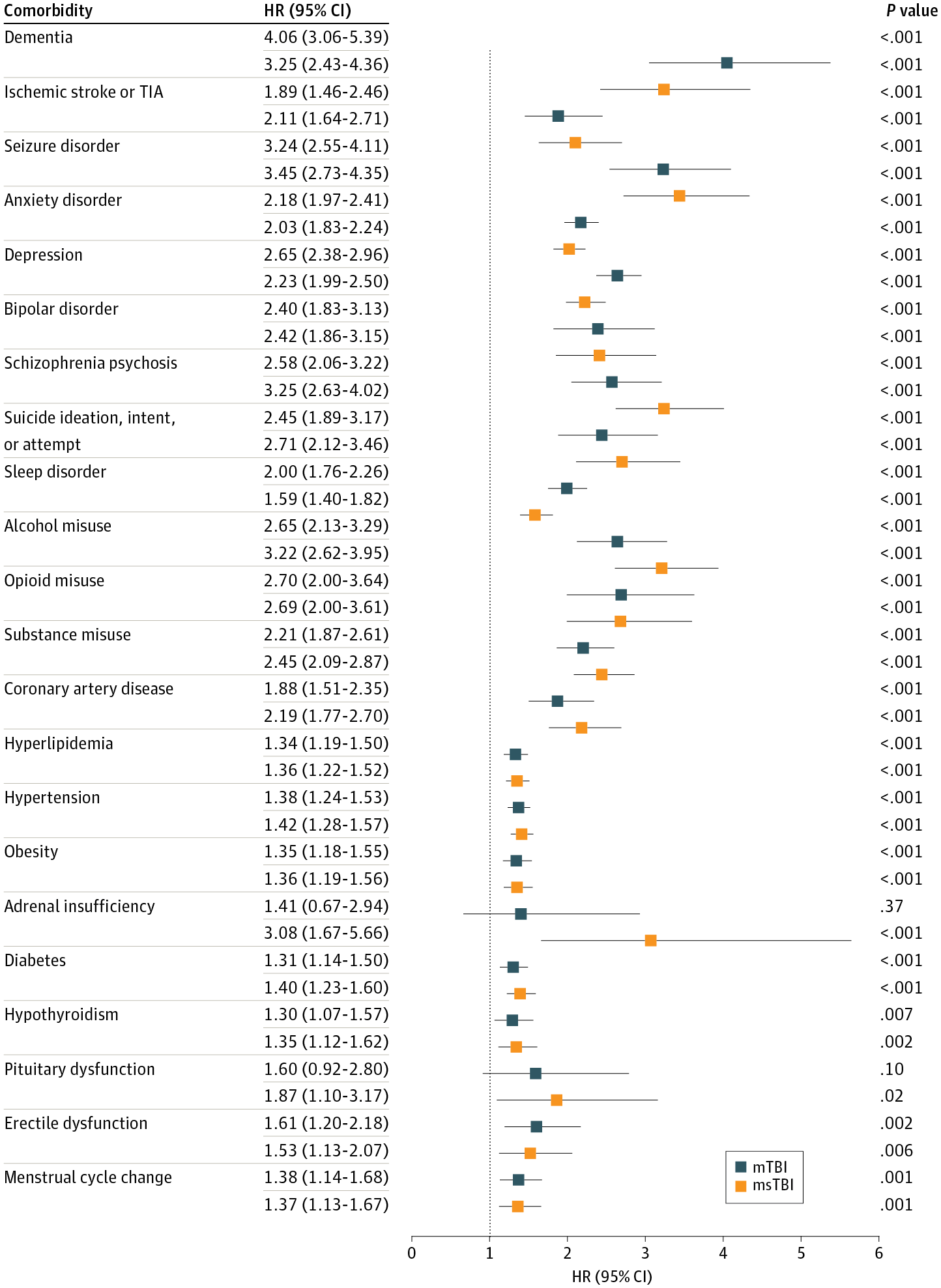 |
- TBI ≠ isolated brain injury: The hazard ratios consistently exceed 1.3 and often surpass 3, so a single TBI appears to set off disease processes well outside the brain.
- Severity matters, but even mild injuries are consequential: While moderate-to-severe TBI generally produced larger HRs, many mild-TBI estimates were comparable (e.g., seizure disorder HR 3.24 vs 3.45).
- Social context shapes outcomes: The ADI stratifications show socioeconomic environment interacting with biological vulnerability, which argues for equity-focused post-injury care.
| Kaplan Meier Curves |
|---|
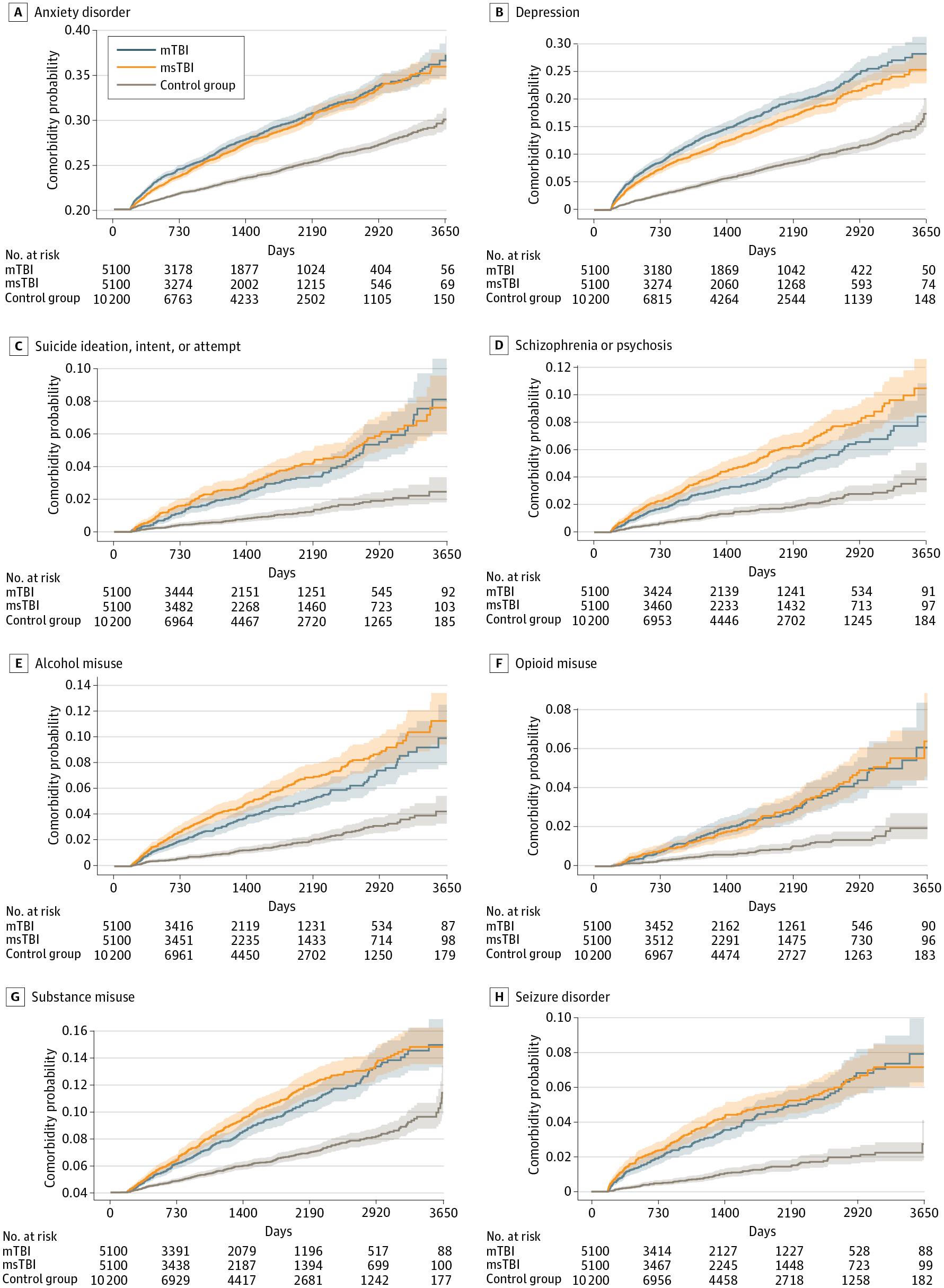 |
- Routine longitudinal surveillance: Screening protocols should extend beyond the first year, incorporating mental-health assessments, metabolic panels, and neurologic checks up to a decade post-injury.
- Targeted mental-health resources: The pronounced suicidality signal, especially in middle-aged adults, warrants proactive counseling and crisis-intervention pathways.
- Integrated care models: Coordination between neurology, psychiatry, cardiology, and endocrinology can catch emerging comorbidities early, reducing morbidity.
- Addressing social determinants: Tailoring follow-up intensity based on ADI may help mitigate disparities; community outreach in high-ADI neighborhoods could be pivotal.
- Reliance on administrative ICD coding (subject to misclassification).
- Lack of Glasgow Coma Scale data; severity inferred from Abbreviated Injury Scale.
- No non-TBI trauma comparator, so some observed risks might reflect injury-related healthcare utilization rather than brain-specific mechanisms.
- Sex-specific analyses were not performed despite a near-equal gender distribution.
Our California cohort validates and extends the prior Massachusetts findings: TBI is a chronic health risk factor with effects across neurological, psychiatric, cardiovascular, and endocrine systems. Treating TBI as a lifelong condition rather than a one-time event should change how follow-up care is structured, and it belongs in research and health-policy planning too.