Why This Study Matters Link to heading
Traumatic brain injury is already recognized as a leading cause of disability worldwide. Yet most large-scale epidemiologic work has either (a) excluded patients with pre-existing psychiatric diagnoses or (b) lacked a non-head trauma comparator. Without one, it is hard to tell whether the observed mental-health sequelae come from the brain injury itself or from the broader trauma experience: hospitalization, pain, loss of function, and so on.
We fill that gap in three ways:
- Including patients with prior mental-health conditions: reflecting real-world clinical populations.
- Propensity-matching TBI patients to orthotrauma patients on age, sex, race/ethnicity, insurance, socioeconomic deprivation, and health-care utilization.
- Tracking both pre-index (-1 year) and post-index (up to +7 years) outcomes, giving a view of baseline risk and the incremental effect of the injury.
Study Design at a Glance Link to heading
| Component | Details |
|---|---|
| Data source | UC Health Data Discovery Portal (UCDDP) – de-identified EHRs from six UC medical centers (≈8.7 million patients). |
| Study period | 2013 – 2022 (injury dates); analyses performed Aug 2024 – Jan 2025. |
| Cohorts | TBI (n=43,596), Orthotrauma (non-head fractures, n=43,596), and Unexposed controls (no TBI/orthotrauma, n=87,192) |
| Matching | 1:1 propensity match on demographics, insurance, Area Deprivation Index, prior visit count; then matched to unexposed (1:2). |
| Outcomes | ICD-10-CM coded diagnoses of depression, anxiety, PTSD, suicidality (ideation/intent/attempt), bipolar disorder, schizophrenia. |
| Analysis | Cox proportional-hazards models (adjusted for documented suicide attempts). Bonferroni-corrected significance threshold p<0.0000625. |
Key Findings Link to heading
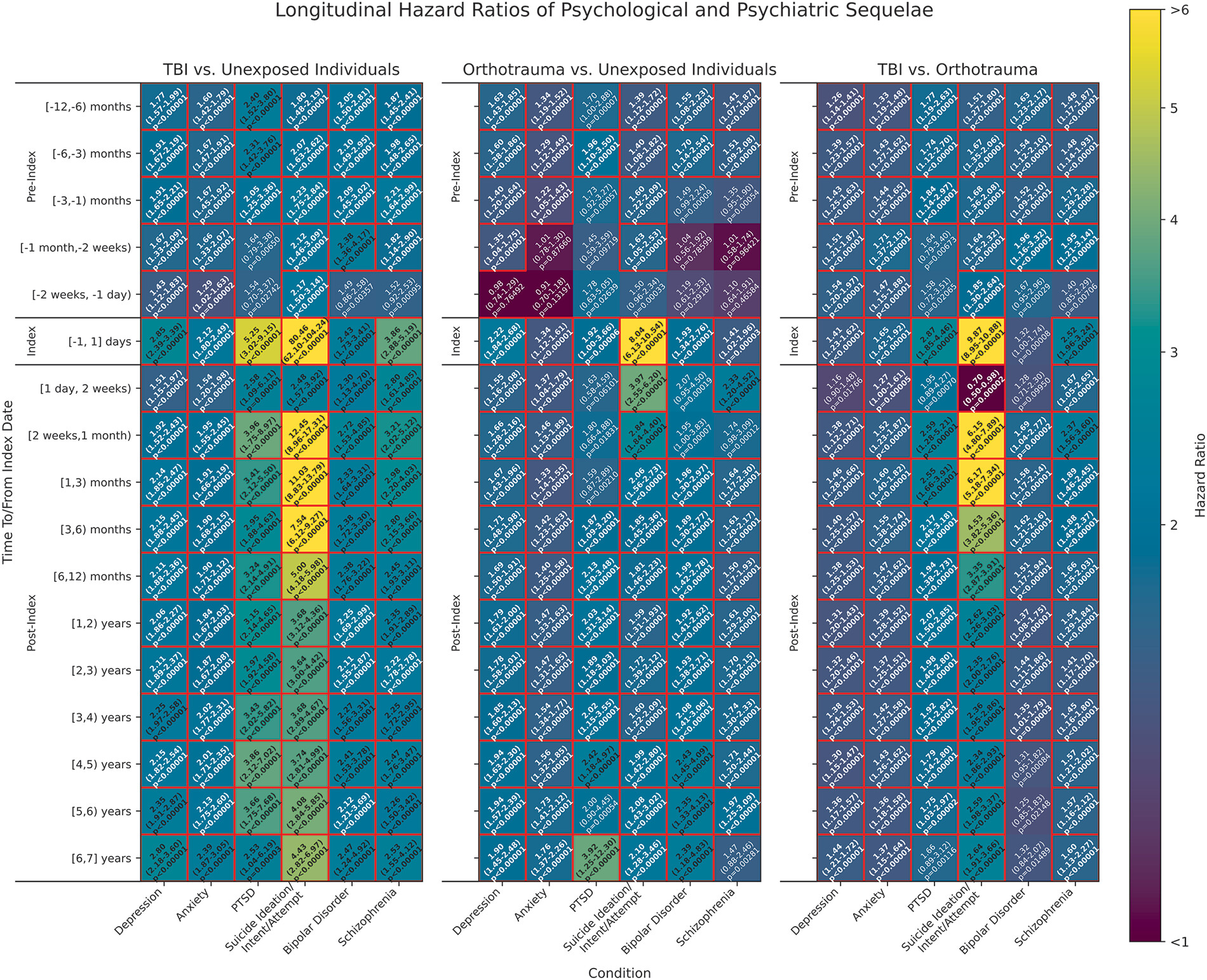
| Overall Hazard Ratios Over Time |
|---|
 |
PTSD Link to heading
- TBI vs. Orthotrauma: Post-injury HR≈1.75–2.59 (through Year 6).
- Pre-injury baseline: HR≈1.74–1.84, indicating already elevated risk before the event.
- Age-specific peaks: Adults (25-43 years) and aged (65-79 years) showed the strongest de-novo post-injury risk.
Suicidality Link to heading
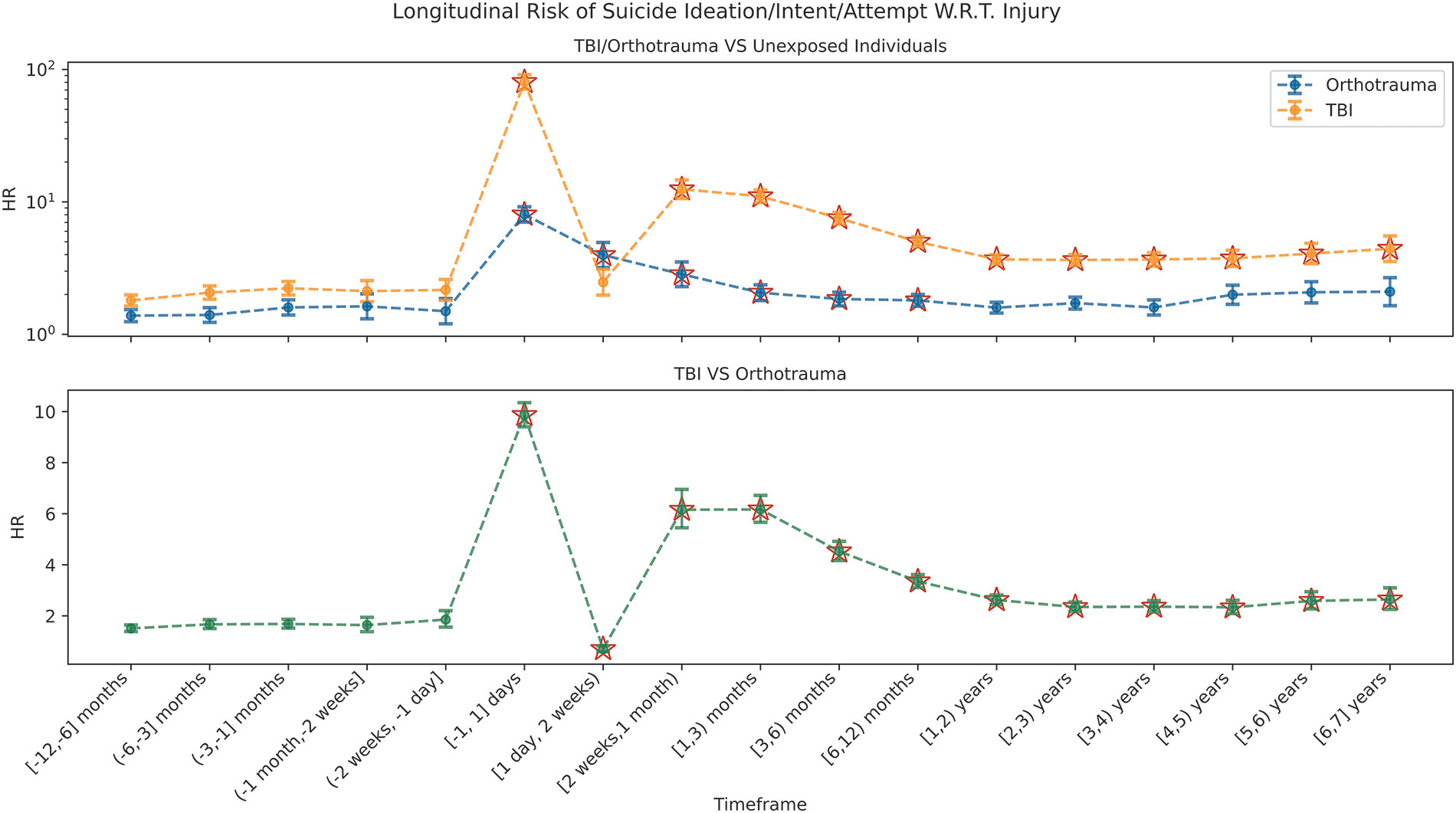
- TBI vs. Orthotrauma: Post-injury HR≈2.34–6.17 (up to Year 7).
- Highest risk window: 6–12 months after injury (HR≈6).
- Pre-injury risk: Already raised (HR≈1.80–2.32).
- Across ages: Young adults (18-24 years) exhibited the steepest rise (HR≈2.6–7.6).
| Suicidality Focus |
|---|
 |
Other Mental-Health Diagnoses Link to heading
| Outcome | General trend (TBI vs. Orthotrauma) |
|---|---|
| Depression | Slightly higher HRs for TBI, but post-injury HRs similar to pre-injury (1.30–1.46). |
| Anxiety | Similar pattern to depression; modest TBI-specific increase in young adults and elderly during early epochs. |
| Bipolar disorder | Elevated pre- and post-injury HRs for TBI (≈2) but no clear divergence from orthotrauma. |
| Schizophrenia | Higher pre-injury HRs for TBI; post-injury HRs rise briefly around the index date then converge. |
Overall, PTSD and suicidality stand out as the most robust TBI-specific mental-health sequelae.
Interpretation & Clinical Implications Link to heading
- Brain-specific pathology matters. The differential hazard between TBI and orthotrauma suggests that neurobiological injury (e.g., disruption of fronto-limbic circuits) contributes uniquely to PTSD and suicidal behavior, beyond the shared stress of any serious trauma.
- Early post-injury window is critical. The 6-12-month surge in suicidality aligns with the period when patients transition from acute care to community living, often hitting gaps in follow-up. Targeted screening and intervention during this window could avert many adverse outcomes.
- Screening should be universal. The study deliberately included patients with prior psychiatric histories, so the findings reinforce that all TBI survivors need systematic mental-health assessment, not just the “clean” cases.
- Risk stratification by age and sex. Both males and females showed heightened risk, but certain age brackets (young adults for suicidality; middle-aged and older adults for PTSD) may benefit from tailored monitoring.
- Policy and health-system actions. Automated EHR alerts (e.g., flagging a TBI diagnosis to trigger a mental-health consult) could operationalize the recommendation for uniform screening.
Limitations Worth Noting Link to heading
- Severity granularity missing. ICD-10 codes cannot differentiate mild vs. severe TBI, nor capture mechanisms (e.g., blast vs. fall).
- Inpatient vs. outpatient not distinguished. The dataset does not separate care settings, which could affect outcome ascertainment.
- Potential residual confounding. Although extensive matching was performed, unmeasured variables (e.g., substance use, social support) may still influence hazard estimates.
- Generalizability. The cohort reflects California’s diverse but specific health-system environment; replication in other regions would strengthen external validity.
Bottom Line for Practitioners & Researchers Link to heading
- TBI is a potent, independent predictor of long-term PTSD and suicidality.
- The first year, especially months 6–12, is a high-yield period for intervention.
- Routine, automated mental-health screening built into trauma pathways could prevent a lot of this morbidity.
Future work should parse out the contribution of injury severity, look for neuroimaging or biomarker correlates of the mental-health risk, and test targeted preventive programs in randomized trials.